
Birding sites in Uganda
While identifying birding sites, a number of factors have to be considered and these include practical matters like road access and signage with African Birding Journeys. Visitors must be able to locate the site and be informed about what type of visitor amenities they will find. Families may be looking for picnic facilities; serious birders may want interpretative services. Safety is another concern for wildlife and for visitors. If people are stopping to visit a birding site, adequate parking is a priority.
Mabamba Bay
Mabamba is an extensive marsh stretching through a long narrow bay, fringed with papyrus towards the main body of Lake Victoria in Mpigi district. Miscanthus and Cyprus species dominate, but there is a narrow open water channel and a small patch of Nymphea caerulea. There are also areas of Cladium mariscus, and sometimes drifting papyrus swamp islands. It forms part of Waiya Bay south west of Nakiwogo Bay; these are all to the west of Entebbe International Airport. This Important Bird Area is one of the best marshy areas along the northern shores of Lake Victoria: it is the closest place to Kampala where Shoebills are regularly seen. The climate is similar to other areas of the northern shoreline of the lake (1200-1500 mm of rain with average minimum temperature of 170C and average maximum temperature of 260C).
Lutembe Bay
Lutembe bay is a secluded backwater at the mouth of Lake Victoria’s Murchison Bay, between Kampala and Entebbe. It is shallow, papyrus-fringed and almost completely cut off from the main body of Lake Victoria by a papyrus island. The dominant vegetation is a mosaic of papyrus on the open waterside, with Miscanthus and Vossia spp. towards the dry land. The bay extends into a Miscanthus swamp and merges with forest remnants to the north and a recently cleared horticultural farm to the northwest on the landward side. Its protection from the wave action of the open water has facilitated the establishment and proliferation of the water hyacinth Eichhornia crassipes. The high rainfall (1,250-1,500 mm) is typically distributed in two seasons, March-May and September-November. There is little variation in temperature throughout the year with an average minimum being 170C and average maximum 260C. The bay and its associated swamps are important for the surrounding communities as a source of raw materials for local crafts, building, water for domestic use and probably more importantly fish as food and income.
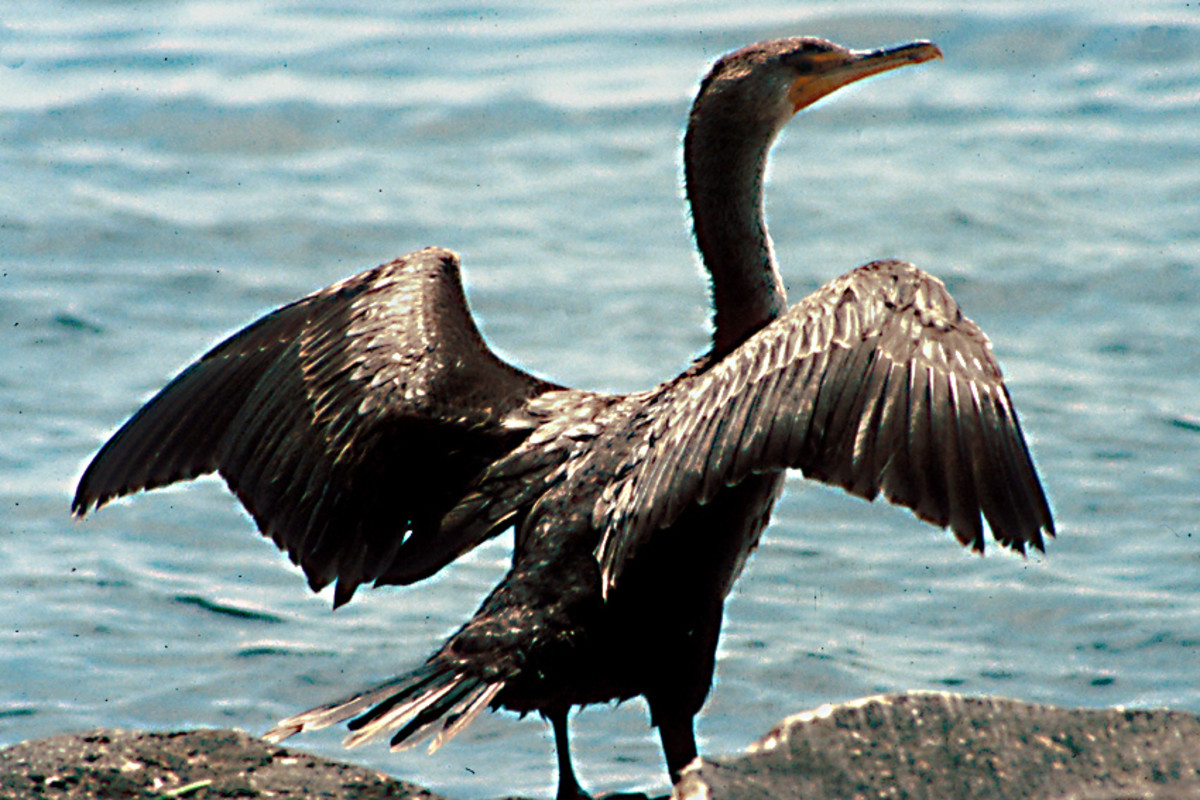
Lutembe Bay that was recently declared a Ramsar site is home to over 100 species of birds. The commonly seen birds include the Papyrus Yellow Warbler, the Papyrus Gonolek, the Greater Cormorant, Gull billed Tern. During winter, others like the Grey-headed gull, Slender-billed gull and White-winged black terns migrate from Europe in their thousands, making a visit to this place a thrilling adventure.
Entebbe Botanical Gardens
The Entebbe Botanical Gardens established in 1898 are situated on the northern shores of Lake Victoria virtually on the equator. Experiencing an annual rainfall of 1623 mm and at an altitude of 1134 meters the gardens are set in 40.7 hectares. The gardens house a collection of species of plants of the tropical, sub-tropical and temperate zones, besides several shrubs and other plants regenerated naturally over the years. The collection as of 1998 numbered 309 species, 199 indigenous to Uganda, 122 with known medicinal value and 110 exotic. The gardens are a popular attraction for visitors of which some 40,000 per year are passing through the gates since the rehabilitation in 1998. The entrance is located close to the Botanical Beach Hotel. Colobus monkeys are common. The gardens are an opportunity for birding enthusiasts to open their birding account for Uganda or merely to add to an existing list. Palm Nut Vulture and African Grey Parrot are resident, whilst Bat Hawk is often seen over the gardens at sunset and is best observed from the Botanical Beach Hotel patio bar. Naturally there are loads of exotic plants and trees.
Zika Forest
Located along Entebbe road, Zika is a small forest, but full of vast mature trees, with luxuriant undergrowth and a thick canopy of leaves in what foresters call the upper storey. A large population of birds and butterflies, and a noisy troop of red-tailed and colobus monkeys inhabit this Uganda Forest. Zika Forest is a gazetted Forest Reserve supported by the Netherlands Committee for the International Union for the Conservation of Nature, in Switzerland (IUCN) and maintained by the Uganda Virus Research Institute in Entebbe, and the Uganda Wildlife Society in Kampala. The forest’s dominant tree population is the ficus, macaranga and mvule.
Budongo Ecotourism Site
Budongo forest covers an area of 793 sq km of which only 53% is forest. The remaining 47% is grassland. Budongo forest is classified as medium altitude semi deciduous moist forest with a generally flat terrain significantly diminishing the risk of long trekking before contact is made with the chimps. It has a high biodiversity with 24 species of small mammals, 9 being primates, 465 species of trees and shrubs, 359 species of birds, 289 species of butterflies, and 130 species of moths.
Kaniyo Pabidi and Busingiro
Kaniyo Pabidi and Busingiro are part of the Budongo Forest reserve. An eco tourism project was set up in 1993 and opened to the public in 1994 for chimpanzee viewing at both sites. These sites are currently managed by The Jane Goodall Institute.
Eco-tourism in Uganda, particularly viewing of highly charismatic species such as chimpanzees, has been considered a useful conservation tool that protects the chosen site and supports the local economy. However, in eco-tourist sites a balance must be struck between tourist demand and site availability. The welfare of the chimpanzees and high standards of the tourist experience need to be guaranteed to insure the long-term success of the project from both the economic and conservation perspectives.
Mabira Birding Forest
Mabira is an ecologically important site for Uganda, it provides a habitat for many species of plants and animals including 312 trees and shrub species, 287 species of birds, 16 small mammals and 199 species of butterflies and 97 species of large months. Mabira has wild robusta coffee, dioscoria tubers, yams and other plants whose economic importance is unknown, which would then be lost.
It is the only large forest in the bio-geographical zone of the Lake Victoria Crescent thus providing the only watershed for this already water stressed area. The watershed feeds the streams that flow into L. Victoria and R Ssezibwa and also provide sources of water for the neighbouring communities.
This is the only forest in central Uganda where forest birding is enjoyable and it is about an hours drive from Kampala. While birding here we expect species which are rare like the Grey and Yellow Longbill, Purple Throated Cuckoo-Shrike, Tit Hylia, Fire Crested Alethe, Olive Green Cameroptera, Blue Shouldered Robinchat, other interesting birds include the Yellow whiskered Greenbul, Leaf love, Toro Olive Greenbul, Buff spotted and Yellow Crested Woodpecker, White spotted Fluff tail, Red headed Blue Bill, Yellow spotted Barbet, Grey throated Barbet, Forest Robin, Yellow Rumped Tinker bird, Yellow Throated Tinker bird, Blue Breasted Kingfisher, African Pygmy, Shining blue, Woodland Kingfishers, Jameson’s Wattle Eye, Red tailed Ant Thrush, Chin spot Batis, Chestnut Wattle Eye, Yellow mantled, Black Billed, Weyn’s Weavers, Violet backed Starling, Red headed Malimbe, Purple headed Starling, and many more attractive species. The European Honey Buzzard is a good winter visitor to this area.